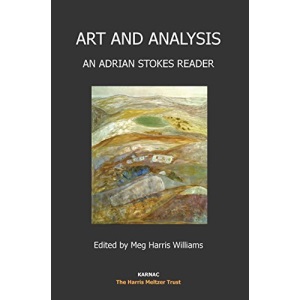
Art and Analysis: An Adrian Stokes Reader (The Harris Meltzer Trust Series)

Art and Analysis: An Adrian Stokes Reader (The Harris Meltzer Trust Series)

by Adrian Stokes (Author), Meg Harris Williams (Editor), Adrian Stokes (Author), Meg Harris Williams (Editor)

Synopsis

This edition is an introductory selection from the writings of Adrian Stokes (1902-1972), the Kleinian aesthete who created a unique vision of the relation between psychoanalysis, art, and aesthetic experience in general. His approach was founded initially on his travels in Italy which then acquired a more formal theoretical foundation during his analysis with Melanie Klein. Stokes was a close friend of leading figures in both psychoanalytic and artistic-literary circles, including Richard Wollheim who organised a previous edition of extracts, The Image in Form. The present edition concentrates specifically on the writing that demonstrates the parallels between art and psychoanalysis.

$32.12

Quantity

1 in stock

More Information

Format: Paperback
Pages: 208
Publisher: Karnac Books
Published: 09 Sep 2014

ISBN 10: 1782201181
ISBN 13: 9781782201182

Media Reviews
'Adrian Stokes' writing is the only criticism today that casts an imaginative spell like art ... He recaptures as much as writing ever has of the actual reverberations of art on one's life.'- Lawrence Gowing, painter, and editor of Critical Writings of Adrian Stokes'If Stokes' early work can be read much as though it belonged to the tradition of nineteenth-century aestheticism, it is to be observed that, throughout, there is a place reserved for psychoanalytic theory, at which it can be introduced when the moment is right.'- Richard Wollheim, philosopher of aesthetics, and editor of The Image in Form: Selected Writings of Adrian Stokes'Adrian Stokes built a bridge between art and psychoanalysis that will stand for generations ... When he embraced psychoanalysis, and the developments of Melanie Klein's thinking, in particular, he did so because the theories seemed to him to throw an unparalleled light on the phenomenology of art as what Wittgenstein has called a form of life ... He sought the mysterious powers of art in its basic references to bodily experience and object relations, to visual configurations, tactile sensations, to the geography of life space, and to the haunting quality of repetition of patterns, the incantatory element, as he called it.'- Donald Meltzer, psychoanalyst'Stokes believed that the contemplation of art, even more than the contemplation of landscape, could bring the spectator to an intuitive understanding of how the often inchoate self might identify with those internal figures that psychoanalysts call good objects . Works of art, he maintained, derive many of their attributes from the ability of both artist and spectator to commune with such objects. Neither work of art nor good object coerce; they invite. They envelop us while at the same time remaining other.'Eric Rhode, psychotherapist and author; editor of A Game that Must be Lost: Collected Papers of Adrian Stokes
Author Bio
Meg Harris Williams, a writer and artist, studied English at the Universities of Cambridge and Oxford and art at the Accademia di Belle Arti in Florence, and has had a lifelong psychoanalytic education. She has written and lectured extensively in the UK and abroad on psychoanalysis and literature, and teaches at the Tavistock Centre in London, and the University of Surrey. She is married with four children and lives in Farnham, Surrey.