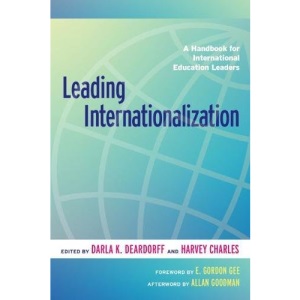
Leading Internationalization: A Handbook for International Education Leaders

Leading Internationalization: A Handbook for International Education Leaders

by Darla K . Deardorff (Editor), HarveyCharles (Editor), Harvey Charles (Editor), Darla K. Deardorff (Editor)

Synopsis

What do university leaders need to know and be able to do to internationalize their institutions?

This volume provides senior professionals in international education, increasingly known as Senior International Officers (SIOs), with the foundational knowledge that informs leadership practices, together with suggested strategies for implementing and developing the wide range of functions, activities and skills associated with comprehensive internationalization that will ensure effective support for their institutions' educational mission in today's globalized and interdependent world.

This book addresses strategic leadership issues in internationalization including strategic planning, shaping the curriculum, recruiting students, risk management, and developing partnerships. Throughout, the Association of International Education Administrators' (AIEA) Standards of Professional Practice for SIOs and International Education Leaders (reproduced in the appendix) are integrated as a point of reference, providing a much needed guide for international education leaders.

This resource is a vital starting point for anyone in a senior leadership role in higher education, as well as for anyone desiring to understand more about this key leadership position essential to higher education institutions in developing institutional global capacity and in educating global-ready graduates.

$40.36

Quantity

5 in stock

More Information

Format: Paperback
Pages: 156
Publisher: Stylus Publishing
Published: 30 Jul 2018

ISBN 10: 162036784X
ISBN 13: 9781620367841

Media Reviews
Leading Internationalization offers insights and guidance on a wide range of critical issues, spanning the practical, strategic, and conceptual. Authors are leading experts in the field of international education, whose wealth of experience as both practitioners and scholars uniquely positions them to contribute meaningfully to the on-going conversations the book is designed to promote. --Robin Matross Helms, Director, Center for Internationalization and Global Engagement American Council on Education
Leading Internationalization provides a comprehensive overview of the way Senior International Officers (SIOs) in the United States of America address leadership issues in the internationalization of their institutions of higher education. The book gives valuable insights into the way internationalization is organized, and in what are the practical challenges and opportunities to implement internationalization strategies in American institutions of higher education. --Hans de Wit, Director Center for International Higher Education, Consulting Editor Policy Reviews in Higher Education, Lynch School of Education Boston College
Leading Internationalization is an essential and comprehensive resource for new and current senior international officers (SIOs). The contributors examine the complexities of the SIO's role while offering practical, purposeful chapters on the key dimensions of the position. They make a compelling case for the professionalization of the SIO position, and detail the nuances on-campus and off-campus alliance building that are critical in achieving success with diverse communities in a methodical and easily applicable manner. --Dawn Michele Whitehead, Senior Director for Global Learning and Curricular Change, Office of Integrative Liberal Learning and the Global Commons AAC&U
From the Afterword:
Ever since they were established, universities have had foreign policies. Those in the world of antiquity issued what we would today regard as visas and sought to attract and protect scholars traveling to them. Emperors agreed and also exempted them, among other things, from taxes and service in armies. And when societies and minds responded to internal and external threats by closing, universities were among the last to shut their gates. And not all did.

What they did not have were foreign ministers, i.e., senior members of a presidential cabinet whose domain was to protect and intentionally ensure that universities would continuously seek and welcome scholars and students from well beyond the nearby community. So perhaps the single most important innovation in our field so far in the 21st century is the creation and development of leadership positions that this important book aims at understanding.

Senior International Officers (SIOs) and international education leaders create and implement strategy and there is still much about this particular realm of statecraft we all have to learn and share. Leading internationalization is a contact sport, as these chapters show, as well as one that requires metrics and results. None of us took such a course because so often we got there because we thought being more intentional about internationalization was the best way to connect our schools and students to the world we share. We are indeed learning on the job and from each other. This book is one strong step in that direction. --Allan Goodman, President Institute of International Education
Author Bio
Darla K. Deardorff is Executive Director of the Association of International Education Administrators and Affiliated Faculty at Duke University, Nelson Mandela University (South Africa), and at Shanghai International Studies University (China).

Harvey Charles is Dean for International Education and Vice Provost for Global Strategy at SUNY-Albany and Past-President of the Association of International Education Administrators.