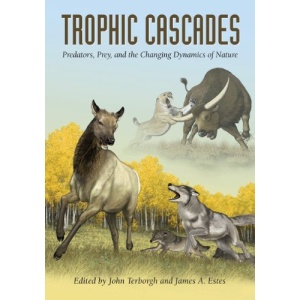
by JohnTerborgh (Author), JamesA.Estes (Editor)
Trophic cascades--the top-down regulation of ecosystems by predators--are an essential aspect of ecosystem function and well-being. Trophic cascades are often drastically disrupted by human interventions--for example, when wolves and cougars are removed, allowing deer and beaver to become destructive--yet have only recently begun to be considered in the development of conservation and management strategies.
Trophic Cascades is the first comprehensive presentation of the science on this subject. It brings together some of the world's leading scientists and researchers to explain the importance of large animals in regulating ecosystems, and to relate that scientific knowledge to practical conservation.
Chapters examine trophic cascades across the world's major biomes, including intertidal habitats, coastal oceans, lakes, nearshore ecosystems, open oceans, tropical forests, boreal and temperate ecosystems, low arctic scrubland, savannas, and islands. Additional chapters consider aboveground/belowground linkages, predation and ecosystem processes, consumer control by megafauna and fire, and alternative states in ecosystems. An introductory chapter offers a concise overview of trophic cascades, while concluding chapters consider theoretical perspectives and comparative issues.
Trophic Cascades provides a scientific basis and justification for the idea that large predators and top-down forcing must be considered in conservation strategies, alongside factors such as habitat preservation and invasive species. It is a groundbreaking work for scientists and managers involved with biodiversity conservation and protection.
Format: Paperback
Pages: 488
Edition: 1
Publisher: Island Press
Published: 03 Jul 2010
ISBN 10: 1597264873
ISBN 13: 9781597264877
John Terborgh is James B. Duke Professor of Environmental Sciences and codirector of the Center for Tropical Conservation at Duke University. He has devoted much of the past 35 years to issues concerning the ecology and conservation of neotropical systems.
After spending most of his career as a research scientist with the US Geological Survey, James A. Estes is currently a faculty member at the University of California at Santa Cruz where he holds a position of professor of ecology and evolutionary biology.


 FREE UK DELIVERY
  Global shipping from £2.99
 FREE UK DELIVERY
 30 Day Refund Guarantee