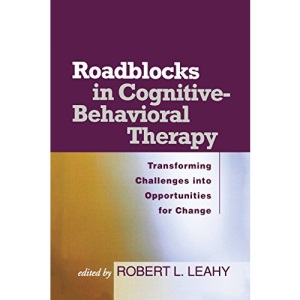
Roadblocks in Cognitive-behavioral Therapy: Transforming Challenges into Opportunities for Change

Roadblocks in Cognitive-behavioral Therapy: Transforming Challenges into Opportunities for Change

by RobertL.Leahy (Editor)

Synopsis

Why do standard, evidence-based interventions fail to work for certain clients or in certain situations? What tools do cognitive-behavioral theory and therapy offer for managing difficult cases? This cutting-edge volume brings together an array of leading practitioners to address these and other critical questions that are often overlooked in the CBT literature. Each research-based chapter addresses a specific kind of "roadblock," exploring how and why it arises and suggesting effective, practical solutions. Topics include overcoming obstacles in the treatment of specific disorders, new directions in case conceptualization, working with emotional and metacognitive processes, and applications to couple and family therapy.

$3.46

Save:$19.21 (85%)

Quantity

2 in stock

More Information

Format: Paperback
Pages: 364
Edition: 1
Publisher: Guilford Press
Published: 04 Sep 2006

ISBN 10: 1593853734
ISBN 13: 9781593853730

Media Reviews
Dr. Robert L. Leahy has brought together leading cognitive-behavioral therapists from around the world to provide a rich compendium of tools and techniques that deals with roadblocks in treatment. He sees resistance as a window into the patient's psyche that needs to be addressed with a collaborative ear. Each chapter addresses specific issues suggesting practical solutions which provide an abundance of specific strategies that can be used by both beginning and seasoned therapists alike. --Muriel Prince Warren, DSW, ACSW

Roadblocks in Cognitive-Behavioral Therapy provides a rich and multifaceted exploration of the many obstacles that can arise in the treatment process. It does a marvelous job of explaining why and how roadblocks occur in therapy with diverse individuals, as well as couples and families, and provides a coherent set of principles for turning obstacles into what Leahy calls windows of opportunity. Filled with clinical wisdom and specific strategies, this volume should be of use to both beginning and experienced clinicians. It could well become a mainstay of professional training programs at all levels. --Steven D. Hollon, Department of Psychology, Vanderbilt University

Leahy, one of cognitive therapy's most prolific and creative writers, has brought together leading therapists in the field to address the important issue of impasses and disruptions in therapeutic progress. With coverage of such areas as case conceptualization, the relationship of cognition to emotion, and the therapeutic relationship, the volume provides a wealth of insights and practical solutions to clinical difficulties. I highly recommend this book and I am sure that, like me, others readers will learn much from it. --Paul Gilbert, FBPsS, Mental Health Research Unit, Kingsway Hospital, Derby, UK

This book will suffer a lot of abuse from being pulled from your office shelf again and again to be pored over for ideas and inspiration. Leahy has pulled together some of the greatest CBT minds to share their thoughts, feelings, and strategies for working with some of our most difficult-to-treat disorders and populations. Whether a neophyte or a veteran therapist, the reader will find new ways to understand obstacles and overcome resistance in its many guises. --Peter J. Bieling, PhD, St. Joseph's Hospital, Hamilton, Ontario, Canada; Department of Psychiatry and Behavioral Neurosciences, McMaster University
Author Bio
Robert L. Leahy, PhD, is Director of the American Institute for Cognitive Therapy in New York and Clinical Professor of Psychology in the Department of Psychiatry at Weill Cornell Medical College in New York. His research focuses on individual differences in theory of emotion regulation. Dr. Leahy is Associate Editor of the International Journal of Cognitive Therapy and is past president of the Association for Behavioral and Cognitive Therapies, the International Association for Cognitive Psychotherapy, and the Academy of Cognitive Therapy. He is the 2014 recipient of the Aaron T. Beck Award from the Academy of Cognitive Therapy.