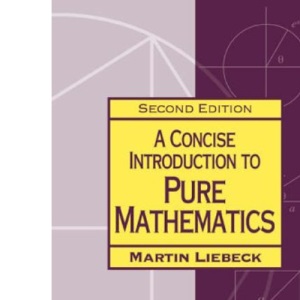
by Martin Liebeck (Author), Martin Liebeck (Author)
Accessible to all students with a sound background in high school mathematics, A Concise Introduction to Pure Mathematics, Third Edition presents some of the most fundamental and beautiful ideas in pure mathematics. It covers not only standard material but also many interesting topics not usually encountered at this level, such as the theory of solving cubic equations, the use of Euler's formula to study the five Platonic solids, the use of prime numbers to encode and decode secret information, and the theory of how to compare the sizes of two infinite sets. New to the Third Edition The third edition of this popular text contains three new chapters that provide an introduction to mathematical analysis. These new chapters introduce the ideas of limits of sequences and continuous functions as well as several interesting applications, such as the use of the intermediate value theorem to prove the existence of nth roots. This edition also includes solutions to all of the odd-numbered exercises. By carefully explaining various topics in analysis, geometry, number theory, and combinatorics, this textbook illustrates the power and beauty of basic mathematical concepts. Written in a rigorous yet accessible style, it continues to provide a robust bridge between high school and higher level mathematics, enabling students to study further courses in abstract algebra and analysis.
Format: Paperback
Pages: 224
Edition: 2
Publisher: Chapman and Hall/CRC
Published: 02 Nov 2005
ISBN 10: 1584885475
ISBN 13: 9781584885474


 FREE UK DELIVERY
  Global shipping from £2.99
 FREE UK DELIVERY
 30 Day Refund Guarantee