by Richard Peet (Author), John M. Hartwick (Author)
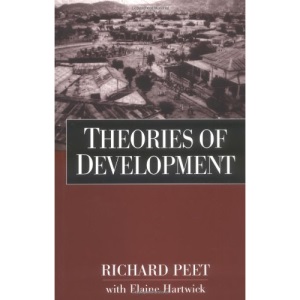
This comprehensive new text surveys the leading theories and models of economic and social development. These include: sociological, economic, neo-Marxist, poststructuralist, feminist and radical democratic approaches. It also explores a range of development models including determinism, modernization, dependency and neoliberalism. Reaching conclusions at odds with much recent literature this book is critical of neo-liberal, market driven economic growth arguing that an alternative democratic form of development remains a viable possibility.
Format: Paperback
Pages: 265
Edition: 1
Publisher: Guilford Press
Published: 07 Oct 1999
ISBN 10: 1572304898
ISBN 13: 9781572304895
Theories of Development is a thoughtful book in both senses--penetrating and packed with ideas. True to its title, it takes the reader through economic, sociological, marxist, post-ist, feminist, and finally, critical realist theories. It is thorough and well referenced. Although it gives intellectual space for theories from a wide range of persuasions, it is a partisan book--and all the better for that. A good read for everyone, and an eminently recommendable text for undergraduate and graduate-level courses on development and social change. --Piers Blaikie, PhD, Professor of Development Studies, University of East Anglia, UK
Development, one of the founding beliefs of the modern world, is in desperate need of reinvention. What better way to do this than through a sweeping and constructive review of conventional and critical theories alike. Shifting their analytical gaze from modernization theory to Marxism, from critiques of post-Enlightment thought to poststructuralism, postcolonialism, and postdevelopmentalism, Peet and Hartwick elegantly lay the basis for 'another development.' Their convincing and eloquent approach reweaves the longstanding traditions of critical modernity and socialism and renews the call for the betterment of the human condition. This book's challenge must be taken seriously by all those interested in the fate of what until now has been known as the third world. Offering an excellent survey of development theories and of social theory more generally, it is a valuable text for undergraduate- and graduate-level courses in development studies, economics, anthropology, geography, women's studies, and sociology. --Arturo Escobar, Department of Anthropology, University of Massachusetts, Amherst


 FREE UK DELIVERY
  Global shipping from £2.99
 FREE UK DELIVERY
 30 Day Refund Guarantee