Media Reviews
'Allender's attention to the interactions between the colonial state and British women who saw themselves as good citizens of the empire working on behalf of Indian women is a noteworthy contribution to our understanding of this period..Learning Femininity is a must-read for historians of empire and imperialism, Indian history, women's/gender history, gender studies, and the history of education.' Geraldine Forbes, State University of New York, Oswego, H-Asia, June 2017 'this book will long remain exemplary... an exceptional mastery of secondary literature, an indispensable reading of the role of women, their networks and their educational projects in India under British rule.' [trans.] Professor Rebecca Rogers, Universite Paris Descartes, Paris, in Clio a lu, Clio, Femmes, Genre Histoire, no. 45 (June, 2017) 'This is an impressively detailed and rich study of the history of the education of girls and women in colonial India, based on extensive archival research in a range of localities.I have no hesitation in heartily recommending this rich and well-researched book to all those interested in the history of education in the nineteenth and early twentieth centuries, particularly the history of colonial education.' Clare Midgley, Sheffield Hallam University, History of Education, February 2017 'In a meticulous study of female education in British India, Tim Allender illuminates the mutual constitution of race and gender over one hundred years of British colonial rule.' Shefali Chandra, Washington University in St Louis, USA, Women's History Review, November 2016 'Allender's work is a compelling account of evolution, growth and development of female education in colonial India which originated within the framework of the state but went on to develop apparatus operating independent of the state that survived and outlived the colonial machinery.' Subhasri Ghosh, Asutosh College, University of Calcutta, Kolkata, India, History of Education Review 'Tim Allender's Learning Femininity in Colonial India, 1820-1932 is a carefully researched and constructed book about British gender, class, and race agendas related to the education of girls and women in India. In a departure from much of the writing on this topic, which focuses on the education of Indian girls and women, the author considers the changing influences and networks of state-sponsored education under the East India Company and British Raj. Allender examines the classroom, hospital, and dispensary, spaces where women of different races interacted and carried out their work under the colonial state, to understand how female education reflected the East India Company and the Raj's attitudes toward women.' Geraldine Forbes, State University of New York, Oswego, H-Asia, June 2017 'Based on a wide array of primary materials from both British and Indian repositories, Allender uses individual case studies along with broad, state-rendered policies to capture the complexities of women's lives on both sides of the colonial divide.' Roberta Wollons, University of Massachusetts, History of Education Quarterly 'A thoroughly researched book drawing together many strands that analyse social processes spanning a century, between 1820 and 1932, and encompassing significant and productive developments in the field of women's education. In a densely written introduction, the author has extremely competently brought together an extensive range of themes and processes that have a bearing on the subject, principally dealing with the interface between the Raj, its policies and colonial subjects. The book has nine chapters, each of which deals with different aspects of colonial education, focusing on the school and medical care. The chapters have a wealth of detail and make for stimulating reading.' Vasanthi Raman, Treasurer Centre for Women's Development Studies, New Delhi, Indian Journal of Gender Studies 'Based on vast archival researchin several continents, Learning Femininity pro-vides a dynamic view of women's education.' Ishita Pande, Queen's University,Historical Studies in Education Vol. 29,no. 2 -- .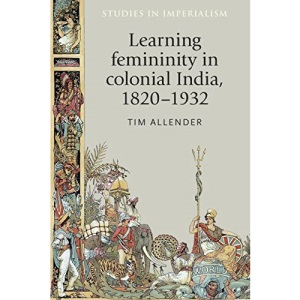


 FREE UK DELIVERY
  Global shipping from £2.99
 FREE UK DELIVERY
 30 Day Refund Guarantee