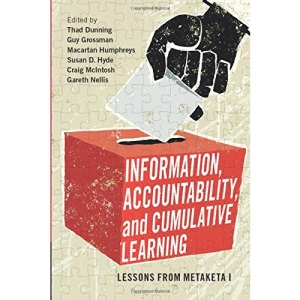
Information, Accountability, and Cumulative Learning: Lessons from Metaketa I (Cambridge Studies in Comparative Politics)

Information, Accountability, and Cumulative Learning: Lessons from Metaketa I (Cambridge Studies in Comparative Politics)

by Thad Dunning (Editor)

Synopsis

Throughout the world, voters lack access to information about politicians, government performance, and public services. Efforts to remedy these informational deficits are numerous. Yet do informational campaigns influence voter behaviour and increase democratic accountability? Through the first project of the Metaketa Initiative, sponsored by the Evidence in Governance and Politics (EGAP) research network, this book aims to address this substantive question and at the same time introduce a new model for cumulative learning that increases coordination among otherwise independent researcher teams. It presents the overall results (using meta-analysis) from six independently conducted but coordinated field experimental studies, the results from each individual study, and the findings from a related evaluation of whether practitioners utilize this information as expected. It also discusses lessons learned from EGAP's efforts to coordinate field experiments, increase replication of theoretically important studies across contexts, and increase the external validity of field experimental research.

$44.19

Quantity

2 in stock

More Information

Format: Paperback
Pages: 504
Publisher: Cambridge University Press
Published: 31 Jul 2019

ISBN 10: 1108435041
ISBN 13: 9781108435048
Book Overview: Examines a set of voter information campaigns worldwide to assess their effectiveness, and develops a new social science research model aimed at cumulative learning.

Media Reviews
This pathbreaking and hugely important book presents and, in a series of illuminating empirical chapters, applies a new method for organizing field experimental research to increase the likelihood of knowledge accumulation from multiple studies. In doing so, it offers the most thoughtful and effective response to date to the challenge of cumulative learning in the field-based social sciences. Daniel N. Posner, James S. Coleman Professor of International Development, UCLA
The Metaketa Initiative represents some of the best of what social science has to offer: rigorous research informed by deep contextual knowledge, focused on urgent questions about how democratic institutions work - and could work better. By employing the highest standards of research transparency and coordinating research across countries, researchers participating in the Metaketa Initiative also directly confronted core methodologic challenges in ways that break new ground. This book is a tremendous contribution to our common search for new and meaningful knowledge in the field of global development and governance. Ruth Levine, Director, Global Development and Population Program, The William and Flora Hewlett Foundation
This book offers more than a multi-site investigation of governance problems in the developing world. It represents a new model of research collaboration and transparency. Many social scientists adduce evidence selectively in an effort to tell an intriguing theoretical story. The authors of this book put spin aside and guide us through the entire process from theoretical inspiration to site selection to data collection. Their analysis of six parallel experiments is guided by plans set out before the results became known, which makes the findings especially convincing. This book will be remembered not simply as a piece of outstanding original scholarship, but as a milestone in the credibility revolution that is unfolding in the social sciences. Donald P. Green, Burgess Professor of Political Science, Columbia University
This is a path-breaking book on multiple levels. It makes a major contribution to our understanding of how ineffective it is to provide voters information and expect improvements in political accountability to result. It also offers a new way to undertake social scientific research that promises greater generalizability of results. Overall, this is one of the most important instances of a multi-project collaborative research initiative in the social sciences to have been conduced in decades. Miriam Golden, Professor of Political Science, University of California, Los Angeles
Author Bio
Thad Dunning is Robson Professor of Political Science at the University of California, Berkeley. Guy Grossman is Associate Professor of Political Science at the University of Pennsylvania. Macartan Humphreys is Professor of Political Science at Columbia University and a Director of the Research group Institutions and Political Inequality at the WZB, Berlin. Susan D. Hyde is Professor of Political Science at the University of California, Berkeley. Craig McIntosh is Professor of Economics at the School of Global Policy and Strategy, University of California, San Diego. Gareth Nellis is Assistant Professor of Political Science at the University of California, San Diego.