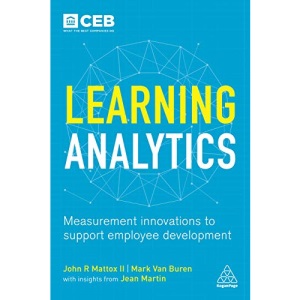
by Mark Van Buren (Author), Mark Van Buren (Author), John R Mattox II (Author), Jean Martin (Author)
Faced with organizations that are more dispersed, a workforce that is more diverse and the pressure to reduce costs, CEOs and CFOs are increasingly asking what the return on investment is from training and development programmes. Learning Analytics provides a framework for understanding how to work with learning analytics at an advanced level. It focuses on the questions that training evaluation is intended to answer: is training effective and how can it be improved? It discusses the field of learning analytics, outlining how and why analytics can be useful, and takes the reader through examples of approaches to answering these questions and looks at the valuable role that technology has to play. Even where technological solutions are employed, the HR or learning and development practitioner needs to understand what questions they should be asking of their data to ensure alignment between training and business needs. Learning Analytics enables both senior L&D and HR professionals as well as CEOs and CFOs to see the transformational power that effective analytics has for building a learning organization, and the impacts that this has on performance, talent management, and competitive advantage. It helps learning and development professionals to make the business case for their activities, demonstrating what is truly adding value and where budgets should be spent, and to deliver a credible service to their business by providing metrics based on which sound business decisions can be made.
Format: Paperback
Pages: 256
Edition: 1
Publisher: Kogan Page
Published: 03 Aug 2016
ISBN 10: 0749476303
ISBN 13: 9780749476304
Book Overview: Provides methodologies for using organizational data to establish where the greatest value can be added in the organization through employee development. Enables learning and development professionals to make the business case for their activities and to deliver a credible service to their business by providing metrics based on which sound business decisions can be made. Gives the practitioner the confidence to ask the right questions of their data and to understand what they are looking for from technological solutions.


 FREE UK DELIVERY
  Global shipping from £2.99
 FREE UK DELIVERY
 30 Day Refund Guarantee