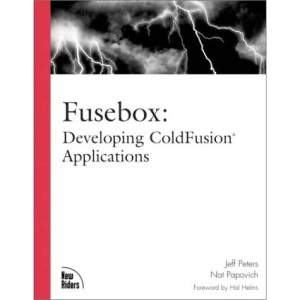
by JeffreyPeters (Author), NatPapovich (Author)
Developers face a constant struggle to launch projects on time and under budget, especially without pulling all-nighters. Fusebox helps ensure successful projects by providing a framework that serves as a base for applications. It's a standard process that makes projects more manageable and simplifies maintenance and requests for change during development. With this book, you'll learn to make ColdFusion applications reliably successful by following a standardized system. In addition, relying on the Fusebox framework to help plan and organize your ColdFusion code will allow you to write increasingly complex and specialized applications.
Jeff Peters and Nat Papovich, both members of the Fusebox Council, share their extensive experience in this book. They'll teach you to use Fusebox with your ColdFusion applications and develop a set of best practices for managing web projects. Read this book if you want to eliminate frustrations and roadblocks in your projects, such as unmanageable complexity, wasteful redundancy of effort, time-consuming code maintenance, and slow development speed.
Format: Paperback
Pages: 456
Edition: 1
Publisher: New Riders Fusebox is a free web application standard that was created as a standard for writing web applications. (This methodology is supported and promoted by Allaire/Macromedia.) The aim of this methodology is to reduce the high failure rate of these applications. If a team of developers uses Fusebox to write ColdFusion applications, the applications will be written more quickly and effectively because they will all code according to the same standard. Nat and Jeffrey start the book by explaining the benefits of using Fusebox and then teach how to use Fusebox's features, demonstrated as they build an application throughout the book. The authors go on to explain concepts such as the Fusebox lifecycle process, testing, and deployment. The companion web site serves as a interactive tool while reading this book. The web site includes databases, files, and code from this book; current enhancements and revisions to the material in this book; links to other Fusebox resources; the latest updates to the core of Fusebox, for any version.
Published: 18 Jun 2002
ISBN 10: 0735712697
ISBN 13: 9780735712690
Book Overview:
About the AuthorsAbout the Authors Jeff Peters has been messing around with computers since terminal meant a teletype. He is currently a program manager with Operational Technologies Services in Vienna, Virginia, a member of the Fusebox Council, and an occasional seminar speaker and instructor. When Jeff's not pushing bits around, he can often be found remodeling rooms with his wife and daughter, or noodling around on bass and guitar. Jeff maintains a Fusebox-related web site at http://www.grokfusebox.com. Nat Papovich, as a member of the Fusebox Council that oversees the development of the standard, has contributed to the formalization of many popular Fusebox concepts and was instrumental in the release of version 3.0. Nat is a Senior Partner and Lead Architect at fusium, offering application development and project consulting, Fusebox training and mentoring, along with tools and products for developers. In addition to being a frequent speaker at ColdFusion events and conferences nationwide, he has written and contributed to many other Fusebox publications. Currently residing in Portland, Oregon, Nat enjoys climbing, biking, and astronomy. He can be reached at nat@fusium.com. (c) Copyright Pearson Education. All rights reserved.


 FREE UK DELIVERY
  Global shipping from £2.99
 FREE UK DELIVERY
 30 Day Refund Guarantee