by JamesCarroll (Author)
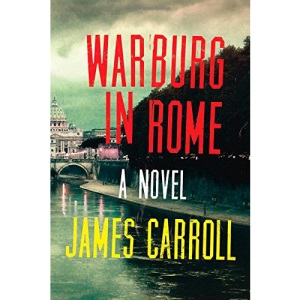
David Warburg, newly minted director of the U.S. War Refugee Board, arrives in Rome at war's end, determined to bring aid to the destitute European Jews streaming into the city. Marguerite d'Erasmo, a French-Italian Red Cross worker with a shadowed past, is initially Warburg's guide to a complicated Rome; while a charismatic young American Catholic priest, Monsignor Kevin Deane, seems equally committed to aiding Italian Jews. But the city is a labyrinth of desperate fugitives, runaway Nazis, Jewish resisters, and criminal Church figures. Marguerite, caught between justice and revenge, is forced to play a double game. At the centre of the maze, Warburg discovers one of history's great scandals - the Vatican ratline, a clandestine escape route maintained by Church officials and providing scores of Nazi war criminals with secret passage to Argentina. Warburg's disillusionment is complete when, turning to American intelligence officials, he learns that the dark secret is not so secret, and that even those he trusts may betray him.
Format: Hardcover
Pages: 384
Publisher: Houghton Mifflin Harcourt
Published: 01 Aug 2014
ISBN 10: 0547738900
ISBN 13: 9780547738901
A well-paced thriller from longtime Vatican watcher Carroll (Crusade, 2004, etc.) set in post-World War II Rome, with the Catholic Church athwart a tangle of scandalous politics and incriminating deeds.
Sanctuary, Sister, is for the guilty. We may not like it, but there it is. So remarks an American monsignor, Kevin Deane, who's working to provide relief to Italian Jews, even as others in the Vatican are seeking to extend that sanctuary to their Nazi persecutors. Into this conflict comes refugee coordinator David Warburg, a confidant of Henry Morgenthau, who has warned him that [o]nce Mark Clark captures it, Rome will be the nerve center and the escape hatch both. If Morgenthau only knew how deeply tunneled that escape hatch was....Helping Warburg--or is she?--is a Red Cross worker named Marguerite d'Erasmo, who came of age as if she were a nun but who has hidden resources, to say nothing of secrets. Marguerite is a person of faith much shaken, for this is a time in which the Madonna seemed indifferent to everyone but her Son, while Warburg is a coolly efficient explorer of the surprising alleys his quest takes him down--not just the Vatican ratline that sweeps Nazis out of the path of the conquering Allies (Rome, as Warburg sees it, is halfway between Vienna and Buenos Aires ), but also a complex storyline that finds highly placed elements within the Vatican opposing Jewish immigration to Palestine on the grounds that by doing so, they are helping to preserve the Holy Land, even as others are aligned with the revived cause of Zionism. Carroll blends a solid command of modern history with a sense for the varieties of evil that have inhabited it--not just the villains, but also the bureaucrats who have self-servingly helped them along and the apologists who have made the world safe for both classes of people.
Though without the white-knuckle tension of Graham Greene's The Third Man, a yarn that's of a piece with it--and a worthy successor. --Kirkus Reviews
Warburg In Rome creates the atmosphere of a thriller with deeply serious historical undertones - the immediate aftermath of the German occupation of Rome. And the laying down of the infamous ratlines that allowed Nazi principals to escape allied capture with aid from the church. And Roosevelt's belated plan to save Jews still in Nazi territory. That's the history part. Fiction enters with a main character named David Warburg, a secular American Jew from northern New England. Roosevelt has charged him with directing the U.S. War Refugee Board and sends him on a mission to Rome, just after the Nazi retreat. Plenty of other strong characters gather around Warburg - some to help and some to disrupt. There's American priest, whom New York's ambitious Cardinal Spellman has assigned to advance his purposes, while in Rome and 24-year-old Marguerite D'Erasmo, a half-French, half-Italian beauty, whom Warburg finds both attractive and useful for his own plans. She's been working in tandem with a group of resisting priests and local Jewish leaders to save the lives of Jews still in fascist captivity. A long struggle ensues to find justice and love in the wake of the war. But the novel remains consistently entertaining, never didactic - even as a reader moves along, hip-deep in the history of the period. Alan Cheuse, All Things Considered
Former priest Carroll (An American Requiem) returns with this complex and compelling novel of the Vatican and morality during World War II. The happenings here are dark indeed, and it's often difficult to believe that the novel is based on real-life events. Lawyer David Warburg comes to Rome to help set up and direct the new U.S. War Refugee Board, an effort that aims to help European Jews rebuild their lives as the war comes to a close. In the course of his humanitarian work, he meets Marguerite d'Erasmo, a Red Cross worker who is motivated by much more than meets the eye. Soon David learns of the Vatican ratline, a system that the Church used to smuggle Nazi war criminals to safety in Argentina. No longer sure whom to trust, he turns to U.S. Intelligence, only to find that the ratline isn't much of a secret after all. VERDICT This is a fresh look at a scandalous chapter of history, and one that reminds us that even when the war was over, the horrors were not. Sensitive readers should beware, as there are some graphic and extremely unsettling scenes. This book deserves a wide readership, and should especially appeal to readers interested in political and religious history. --Library Journal
James Carroll's 'Warburg in Rome' has many of the ingredients of a great spy thriller: a high-stakes battle between good and evil; a plot full of twists and turns; a cultural capital both seductive and corrupt; characters caught in ethical thickets; and a moment of existential crisis when all the world's troubles seem to converge on a single point on the map, bringing out the best and the worst in all who happen to find themselves at the fractured center of civilization. --The Boston Globe
A gripping political thriller set in a world of troubling moral complexity. --WBUR

 FREE UK DELIVERY
  Global shipping from £2.99
 FREE UK DELIVERY
 30 Day Refund Guarantee