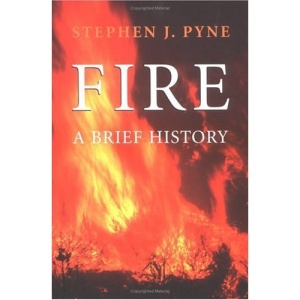
by StephenJ.Pyne (Author)
The fate of humanity, like the fate of the earth, is tied to the fires that have made the world as we know it-the fires whose history is told as well in this book as it has ever been told before. If one wants to understand just how completely the story of the human past is also the story of fire on earth, there is no better place to start than this small book. -William Cronon
Here, in one concise book, is the essential story of fire. Noted environmental historian Stephen J. Pyne describes the evolution of fire through prehistoric and historic times down to the present, examining contemporary attitudes from a long-range, informed perspective. Fire: A Brief History surveys the principles behind aboriginal and agricultural fire practices, the characteristics of urban fire, and the relationship between controlled combustion and technology. Pyne describes how fire's role in cities, suburbs, exurbs, and wildlands has been shaped by an industrialized, urban way of thinking.
Fire: A Brief History will be of value to readers interested in the environment from the standpoint of anthropology, geography, forestry, science and technology, history, or the humanities.
Format: Paperback
Pages: 204
Publisher: University of Washington Press The essential story of fire by a noted environmental historian
Published: Oct 2001
ISBN 10: 029598144X
ISBN 13: 9780295981444
Book Overview:
Fire: A Brief History packs into one slender volume a sweeping tale of fire, and man's interactions with fire, from prehistory to the dawn of the twenty-first century. Pyne's perceptive words and tightly organized sentences allow him to suggest many thought-provoking ideas and to bring to his audiencea fascinating story of fire's role in shaping our world.
* H-Net Book Review *An excellent overview of why the history of humanity cannot be told without the history of fire. . . . An excellent book and strongly recommended for all audiences, especially those with interests in anthropology, geography, history, natural sciences, or the humanities.
* Choice *Stephen J. Pyne writes about fire as if he were on fire, with searing, consuming heat and light. When he looks at fire he sees not biological catastrophe but social illumination and natural renewal.
* Seattle Times *No one is better qualified to teach us about fire's history, fire's crucial role in shaping landscapes, than Stephen Pyne. His discussions of forestry, land-management elitism, pastoral incendiarism, nature reserves, the conservation movement and the ecology of disturbance are profoundly valuable.
* New York Times Book Review *Pyne is the world's leading authority on the history of fire, and his erudition is phenomenal. He offers us a broad panorama of ecological and human history in a framework of geology and geography. He shows what a great impact fire has had in shaping landscapes, flora, and fauna all over the world, and how in the late Pleistocene humans have, as it were, joined forces with fire by learning to manipulate it.
* Science *Pyne weaves together with rare interdisciplinary skill science, ecology, and the arts and humanities to write the history of human involvement with fire in all its manifestations and meanings.
* American Forests *Vestal Fire taught me more about European and world history than any other single book I have ever read, abounding, as it does, in new information, new ideas, and new understandings of the past, thanks to Stephen J. Pyne's energetic and imaginative inquiry into the unique partnership between humans and fire.
* American Historical Review *

 FREE UK DELIVERY
  Global shipping from £2.99
 FREE UK DELIVERY
 30 Day Refund Guarantee