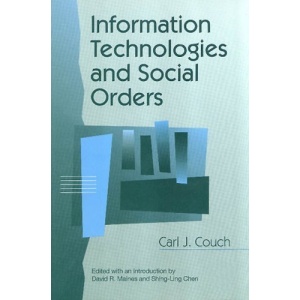
by David R . Maines (Editor), Carl J . Couch (Editor), Chien Shing - Ling (Editor)
The history of human society, as Carl Couch recounts it in his speculative final book, is a history of successive, sometimes overlapping information technologies used to process the varied symbolic representations that inform particular social contexts. Couch departs from earlier media theorists who ignored these contexts in order to concentrate on the technologies themselves. Here, instead, he adopts a consistent theory of interpersonal and intergroup relations to depict the essential interface between the technologies and the social contexts. He emphasizes the dynamic and formative capacities of such technologies, and places them within the major institutional relations of societies of any size. Social orders are viewed in these pages as inherently and reflexively shaped by the information technologies that participants in the institutions use to carry out their work. The manuscript was nearly complete in draft at the time of Couch's death. He has left a bold, synthetic statement, reclaiming the common ground of sociology and communication studies and articulating the indispensability of each for the other. With admirable scope, across historical epochs and cultures, he shows in detail the transformative power of information technologies. While the author hopes that a humane vision comes with each technological advance, he nonetheless describes the numerous instances of mass brutality and oppression that have resulted from the oligarchic control of those technologies. Couch's theory and substantive analysis speak directly to the interests of historians, sociologists, and communication scholars.
Format: Paperback
Pages: 272
Publisher: AldineTransaction
Published: 31 Dec 1996
ISBN 10: 0202305163
ISBN 13: 9780202305165
In this work the late Carl J. Couch surveys the history of human society in terms of information technologies. Good sociologist that he was, Couch views each technology as possessing the potential for both liberating and repressive consequences, what he refers to as a blessing and a burden. More important, he does not posit a theory of technological determinism, but rather argues that the impact of technology has to a large extent been determined by how it has been meshed with social structures.. . Information is so central to modern societies that the primary knowledge centers, i.e., universities, complete with state and economic structures for hegemony in programming the future endeavors of humanity. Through his emphasis on the social context, Couch has brought an important balance to the study of information technologies. Undergraduates.
--M. Oromaner, Choice
In this work the late Carl J. Couch surveys the history of human society in terms of information technologies. Good sociologist that he was, Couch views each technology as possessing the potential for both liberating and repressive consequences, what he refers to as a blessing and a burden. More important, he does not posit a theory of technological determinism, but rather argues that the impact of technology has to a large extent been determined by how it has been meshed with social structures.. . Information is so central to modern societies that the primary knowledge centers, i.e., universities, complete with state and economic structures for hegemony in programming the future endeavors of humanity. Through his emphasis on the social context, Couch has brought an important balance to the study of information technologies. Undergraduates.
--M. Oromaner, Choice
-In this work the late Carl J. Couch surveys the history of human society in terms of information technologies. Good sociologist that he was, Couch views each technology as possessing the potential for both liberating and repressive consequences, what he refers to as a blessing and a burden. More important, he does not posit a theory of technological determinism, but rather argues that the impact of technology -has to a large extent been determined by how it has been meshed with social structures-... Information is so central to modern societies that the primary knowledge centers, i.e., universities, -complete with state and economic structures for hegemony in programming the future endeavors of humanity.- Through his emphasis on the social context, Couch has brought an important balance to the study of information technologies. Undergraduates.-
--M. Oromaner, Choice


 FREE UK DELIVERY
  Global shipping from £2.99
 FREE UK DELIVERY
 30 Day Refund Guarantee