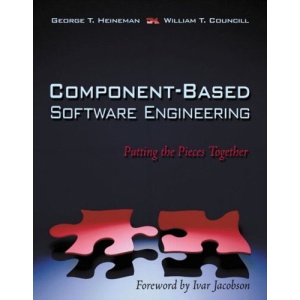
by George Heineman (Author), WilliamT.Councill (Author)
Written by leading experts from around the world, this book presents the latest concepts and practices in Component-Based Software Engineering (CBSE). While detailing both the advantages and the limitations of CBSE, the book's underlying aim is to define this new field, to frame the discussion, and to ensure that students have the background they need to ask good questions and make informed decisions about components.
Format: Hardcover
Pages: 880
Edition: 1
Publisher: Addison Wesley Software components are increasingly central to efficient, cost-effective software development. In this book, the world's leading experts on component software development come together to present the field's state of the art, and to offer new insights into the key challenges of component architecture and reuse. With original contributions by leaders such as Ivar Jacobson, Martin Griss, Len Bass, Paul Clements, Don Reifer, and Will Tracz, this carefully edited book is the first word on components: a tool for helping practitioners get the most out of all their component-based resources. It offers new insight for deciding whether and how to implement component-based development strategies; as well as a clear understanding of the obstacles to successful component development, and best practices responses. The contributors review diverse approaches to component development, present state-of-the-art processes for building component-based systems, and introduce new research directions that will impact component development in the coming decade. For software developers, designers and architects; business analysts; technology executives; computer science and software engineering researchers; project managers; QA specialists, and other professionals.
Published: 08 Jun 2001
ISBN 10: 0201704854
ISBN 13: 9780201704853
Book Overview:
George T. Heineman is an Assistant Professor of Computer Science at Worcester Polytechnic Institute (WPI). He has worked as a Research Scientist at IBM Center for Advanced Studies (Toronto, Canada), Bull Electronics, and AT&T Bell Laboratories. He has consulted for Genetics Institute (Cambridge, MA).
Prof. Heineman received a prestigious National Science Foundation (NSF) Early Faculty Career Development Award (CAREER) in Software Engineering in 1998. This research grant funds the ADAPT project investigating the design of adaptable software components. He also receives funding from the Defense Advanced Research Projects Agency (DARPA). Besides government funding, his lab has received funding and hardware donations from Natural Microsystems and Intellution, Inc.
George Heineman has authored or co-authored over 20 articles and papers on software engineering topics, including component adaptation techniques, component-based software engineering, software development environments, and software process. He also has interests in advanced concurrency control techniques.
Heineman received his Ph.D. (1996) and M.S. (1990) from the Computer Science Department of Columbia University. His advisor was Gail Kaiser, Ph.D. George Heineman earned his BA (1989) in Computer Science from Dartmouth College.
Bill Councill is a partner in Texas Quintessence Corporation. Currently, he is devoting all his time as co-editor of the forthcoming book, Component-Based Software Engineering: Putting the Pieces Together. Previously, he was Systems and Software Process Manager for Mannatech, Inc. His experience includes the development of systems processes and component-based software development processes and methodologies, as well as the following:
He has dedicated the last nine years of his life to absorbing and practicing knowledge from the emerging field of software engineering. He has a master's degree in counseling and devoted 18 years of his life to counseling patients in pain and those with difficult psychiatric diagnoses. Additionally, he earned a Juris Doctor degree. After the award of the law degree, Bill worked in the fields of health care consulting and administrative lobbying.
He entered the discipline of software engineering as the founder of PenKnowledge, Inc. and was the originator of Doctor's Office 3.0, a computer-based patient record system. The system incorporated Microsoft Windows for Workgroups, pen computing across a radio frequency LAN, as well as the replication of data among client and server SQL databases. Mr. Councill participated in the slowly emerging standards for computer-based patient record systems by contributing to the work on digital signatures, confidentiality and security, and the functionality of computer-based record-keeping systems.


 FREE UK DELIVERY
  Global shipping from £2.99
 FREE UK DELIVERY
 30 Day Refund Guarantee