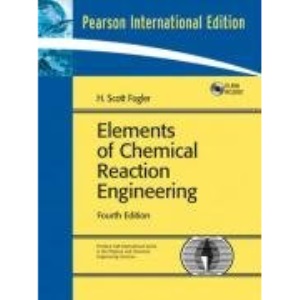
by H.ScottFogler (Author)
The Definitive, Fully Updated Guide to Solving Real-World Chemical Reaction Engineering Problems
The fourth edition of Elements of Chemical Reaction Engineering is a completely revised version of the worldwide best-selling book. It combines authoritative coverage of the principles of chemical reaction engineering with an unsurpassed focus on critical thinking and creative problem solving, employing open-ended questions and stressing the Socratic method. Clear and superbly organized, it integrates text, visuals, and computer simulations to help readers solve even the most challenging problems through reasoning, rather than by memorizing equations.
Thorough coverage of the fundamentals of chemical reaction engineering forms the backbone of this trusted text. To enhance the transfer of core skills to real-life settings, three styles of problems are included for each subject
H. Scott Fogler has updated his classic text to provide even more coverage of bioreactions, industrial chemistry with real reactors and reactions, and an even broader range of applications, along with the newest digital techniques, such as FEMLAB. The fourth edition of Elements of Chemical Reaction Engineering contains wide-ranging examples-from smog to blood clotting, ethylene oxide production to tissue engineering, antifreeze to cobra bites, and computer chip manufacturing to chemical plant safety.
About the CD-ROMThe CD-ROM offers numerous enrichment opportunities for both students and instructors, including the following Learning Resources:
Throughout the book, icons help readers link concepts and procedures to the material on the CD-ROM for fully integrated learning and reference.
Format: Paperback
Pages: 1120
Edition: 4
Publisher: Pearson Great structure to ensure principles are clearly understood and can be appliedafter the completion of the book. This is achieved first through a discussion ofcritical thinking and how Socratic questioning is at the heart of criticalthinking, followed by examples of critical thinking questions, and then finallyexercises on critical thinking. Contains more coverage of industrial chemistrywith real reactors and real reactions and extends the wide range of applicationsto which chemical reaction engineering principles can be applied. Through theuse of an interactive CDROM that is shrunk wrapped with the text andcorresponding web page the book and resource material is designed to addressdifferent student learning styles according to the Felder-Solomon LearningStyle Index. (e.g. global/sequential, active/reflective, verbal/visual andsensing/intuitive)
Published: 01 Aug 2004
ISBN 10: 0131278398
ISBN 13: 9780131278394
Book Overview:
H. Scott Fogler is the Arthur F. Thurnau Professor, Vennema Professor of Chemical Engineering at the University of Michigan. His research interests include flow and reaction in porous media, fused chemical relations, gellation kinetics, and chemical reaction engineering problems in the petroleum industry. He has graduated 37 Ph.D. students and has more than 200 refereed publications in these areas. Fogler is the AIChE 2008 President-elect. He has chaired ASEE's Chemical Engineering Division, served as director of the American Institute of Chemical Engineers, earned the Warren K. Lewis Award from AIChE for contributions to chemical engineering education, and received the Chemical Manufacturers Association's National Catalyst Award. He is the co-author of the bestselling textbook Strategies for Creative Problem Solving, Second Edition (Prentice Hall, 2008).


 FREE UK DELIVERY
  Global shipping from £2.99
 FREE UK DELIVERY
 30 Day Refund Guarantee